China And Singapore Record Slowest Growth In 2024
New research from Savills sees rents for prime residential property continue to outperform capital values, though declining interest rates mean that the scale of the outperformance is lessening.
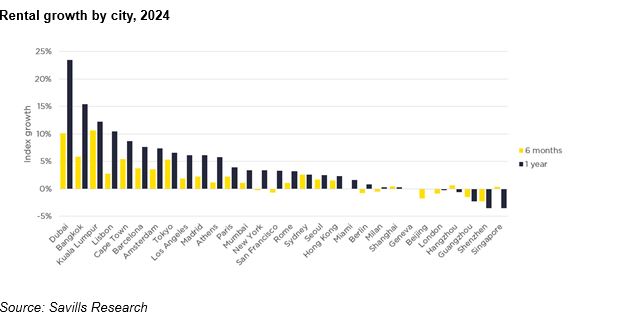
25 of the 30 cities monitored in the Savills Prime Residential World Cities Index saw positive rental value growth over the course of 2024 with rental values increasing by 4.3%, on average, over the index as a whole.
Dubai, Bangkok and Kuala Lumpur lead the chart with Dubai continuing to move from strength to strength in its prime rental market. With a surge of new residents from across the region and the globe, prime rental values have increased by 23.5% over 2024, surpassing the 2016 market peak.
The prime residential rental market in Bangkok saw a 15.4% increase in prices in 2024, driven by strong demand from high-net-worth individuals, increased tourist arrivals, and a growing number of expatriates. The steady recovery of the hospitality and business sectors further enhanced demand for prime rental properties.
Kuala Lumpur has seen a 12.2% increase in prime rental values as a result of stronger market sentiment and confidence in the prime residential market. The trend can be associated with the increased demands for short-term stays, especially with the return of tourists due to the visa-free policy for Chinese and Indian travellers.
European cities have also seen strong rental growth in 2024, with Barcelona, Amsterdam, Madrid, and Athens each reporting increases of more than 5% for the year. In Spain, supply remains scarce in both Barcelona and Madrid, supporting the upward trend in rental prices. Lower levels of high-quality rental stock are also contributing to prime rental increases in Amsterdam and Athens, with legislative changes in Amsterdam, such as the Affordable Housing Act, expected to affect demand positively for prime residential housing as private rental supply decreases.
With the residential sales market in the United States moving slowly because of higher interest rates, many prospective buyers have turned to the prime rental markets. New York, Los Angeles, and San Francisco have each seen prime rental price growth of over 3% in 2024. Miami is also seeing elevated rents, with increases of 1.6% on the year.
Cities in China and Singapore have seen less robust rental growth over 2024. In Singapore, there was an increase in rental transactions in the prime areas, particularly for smaller units. This can be attributed to growing demand from tenants who were previously priced out of the market and have moved to other less costlier accommodations.
Alan Cheong, Executive Director, Research & Consultancy, Savills Singapore comments, “Although luxury apartment rents in Singapore have been on the decline in 2024, it may show better resilience this year as the drive to attract new technology companies in the area of artificial intelligence could boost demand for such centrally located units.”
Some Chinese cities have seen rental price falls over 2024, including Beijing (-0.1%), Hangzhou (-0.6%), Guangzhou (-2.3%), and Shenzhen (-3.5%). Demand across these markets have yet to recover to pre-Covid levels and the market for rental properties, both prime and mainstream, remains challenging.
Across an average of all world cities, prime gross yields moved out by five basis points in 2024 to 3.15% as global rental markets recorded stronger growth than the sales markets.
Yields moved out fastest in Dubai, to 5.3% (+60 bps) and in Kuala Lumpur to 4.3% (+38bps).
Other high-yielding cities include New York, Cape Town, and Amsterdam – three markets which saw high levels of rental growth over the course of 2024. While each location is forecasting strong capital value growth over 2025, rents are expected to continue to outperform which should support higher yields.
Kelcie Sellers, Associate Director, Savills World Research says, “While interest rates remain elevated, many would-be buyers will likely continue to turn to the prime rental markets. For 2025, prime rental prices are forecast to see a slight increase for the 30 cities covered in the World Cities index, but this growth will likely remain below the historic average.
“Dubai is forecast to lead the index for rental growth in 2025 with predicted increase of more than 10%. The market has seen a surge in demand from domestic and international renters who are looking to obtain a piece of the Dubai lifestyle.”